Loving Eyes is a Knipe procedure for dissociative work, not a standalone therapy
EMDR Loving Eyes: origin, evidence, training, and safety limits
Review Loving Eyes provenance, dissociation context, evidence limits, protected training material, consent, and remote-session safeguards.
By the EMDRSuite Editorial Team
Product claims checked against the current EMDRSuite code and interface.
No independent clinical reviewer is named for this guide.
Loving Eyes belongs to Knipe's work with dissociative processes
Jim Knipe presents Loving Eyes in the EMDR Toolbox within a wider adaptive information processing framework for complex PTSD, psychological defenses, and dissociative personality structure. The publisher places it in a chapter about one part looking toward another, not as a generic eye-contact exercise.
Professional references describe compassionate present-day attention toward a younger or distressed self-state. That description establishes lineage and intended context; it does not make Loving Eyes standard eight-phase EMDR, ego-state therapy as a whole, or a validated treatment by itself.
Clinical use is documented more strongly than isolated efficacy
Books, training resources, case examples, and practitioner reports describe the procedure. A 2026 peer-reviewed EMDR Toolbox Method paper states that evidence for the wider method remains primarily empirical and grounded in clinical practice, while calling for clinical trials.
No controlled clinical trial isolating Loving Eyes was identified in the sources reviewed through 28 August 2026. Outcomes from complete EMDR treatment, dissociation care, or complex-trauma programs cannot be assigned to this one procedure.
Parts language must preserve agency and diagnostic humility
A parts metaphor may be useful for some people and alienating, suggestive, or destabilizing for others. It must not be used to diagnose DID, imply literal separate persons, manufacture a childhood narrative, or confirm the historical accuracy of an image or feeling.
Assess orientation, dissociation, self-harm, psychosis, substance effects, current danger, and the person's preferred language. Consent includes declining the metaphor, pausing, changing focus, and receiving care consistent with competence and local scope.
Remote delivery needs presence, observation, and a fallback
Virtual guidance requires a known location, privacy, reconnection and emergency plans, visible or verbal stop signals, enough closure time, and alternatives if gaze, imagery, or inward attention reduces orientation. A recording or copied worksheet cannot monitor those changes.
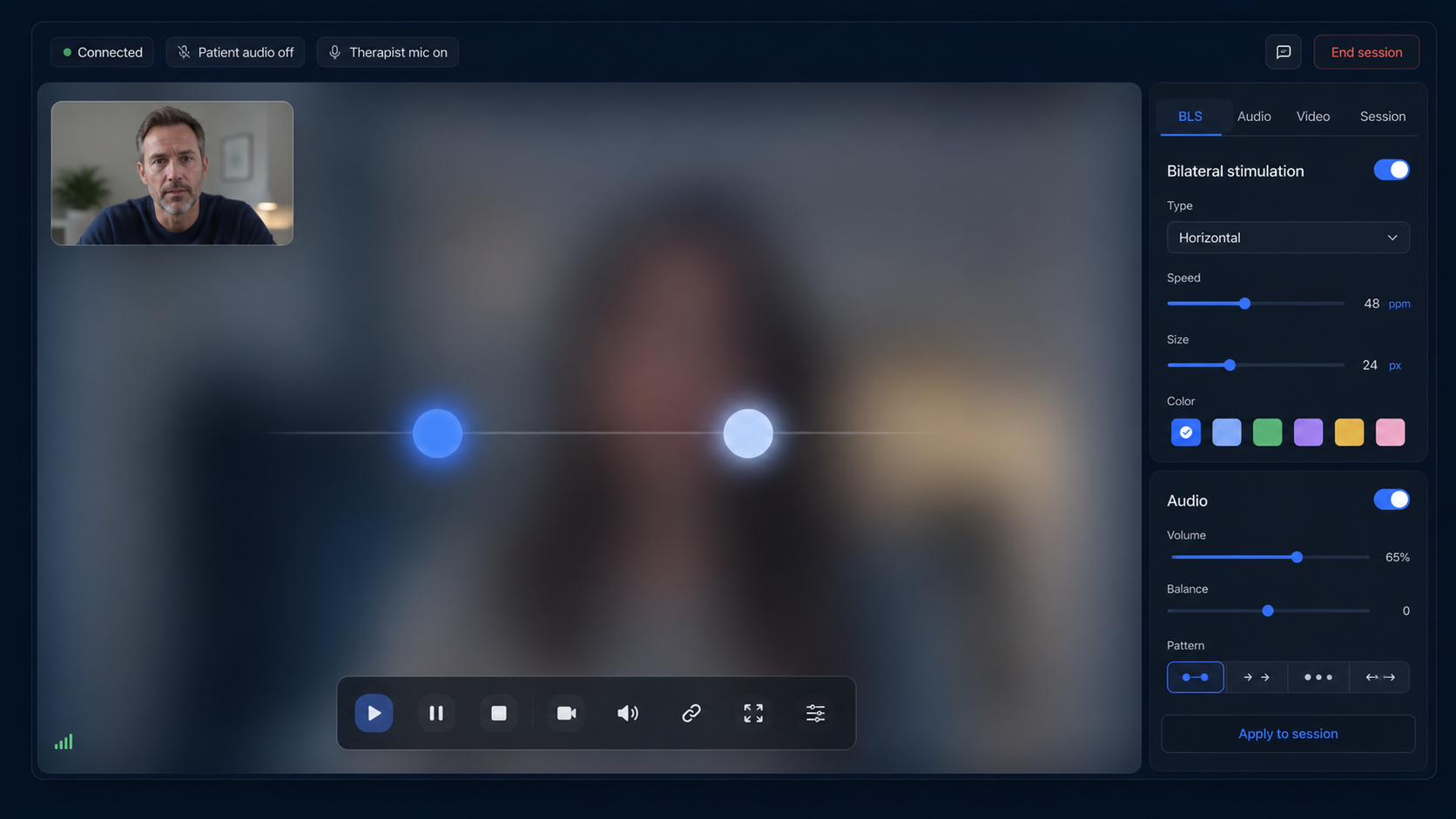
EMDRSuite supports therapist-led video and bilateral stimulation. It does not contain Loving Eyes instructions, identify self-states, infer dissociation, reproduce Knipe's protected material, or replace advanced training and supervision.
FAQ
EMDR Loving Eyes
Who developed Loving Eyes?
Jim Knipe presents the procedure in his EMDR Toolbox work on complex PTSD and dissociation.
Is Loving Eyes standard EMDR?
No. It is an additional procedure used within a broader formulation, not the standard eight-phase protocol by itself.
Does Loving Eyes have an isolated controlled trial?
No controlled trial isolating the procedure was identified through 28 August 2026.
Does EMDRSuite provide the Loving Eyes protocol?
No. It provides session technology, not protected instructions, dissociation assessment, training, or supervision.
References
EMDR Loving Eyes: origin, evidence, training, and safety limits
EMDRSuite
Put the guide into practice with EMDRSuite
Run remote EMDR with visual BLS, bilateral sounds, secure patient links, video-ready sessions, saved settings, and notes.
Continue with related EMDR guides