Spiral Technique is an imaginal stress-management strategy, not a proven mechanism
EMDR Spiral Technique: purpose, evidence, and clinical limits
Distinguish Spiral Technique from processing and grounding while reviewing its training lineage, evidence gap, adaptations, and remote safeguards.
By the EMDRSuite Editorial Team
Product claims checked against the current EMDRSuite code and interface.
No independent clinical reviewer is named for this guide.
The technique works with an imagined quality of body sensation
Training materials attribute Spiral Technique to Shapiro's additional stress-management strategies for incomplete sessions or stabilization. The clinician invites observation of a current body sensation through a spiral metaphor and notices whether deliberate imagery changes the experience.
It is not bilateral stimulation, the phase-six body scan, standard desensitization, a cognitive interweave, vestibular treatment, or proof that distress literally rotates in the body. A metaphor can organize attention without describing a biological mechanism.
The evidence gap must be stated directly
The professional literature supports EMDR as a complete trauma-focused treatment for PTSD, while reviews of resourcing call for component-level controlled research. That broader evidence cannot be assigned to every preparatory exercise.
No controlled clinical outcome trial isolating Spiral Technique was identified in the sources reviewed through 28 August 2026. A reported SUD change during imagery does not establish specific mechanism, diagnostic treatment, durability, or superiority to grounding, breathing, expectancy, or therapist attention.
Not everyone visualizes movement or benefits from reversing it
A person may perceive no direction, experience dizziness, migraine, dissociation, motion sensitivity, neurological symptoms, frustration, or increased distress. Accept no image, no change, or a request to stop; do not pressure the person to produce the expected response.
Assess medical red flags and current orientation, offer nonvisual alternatives, and document what was observed rather than saying energy was released. The exercise must not delay urgent medical or psychiatric care.
Remote use needs live feedback and a fallback
Before using evocative imagery remotely, confirm privacy, location, emergency contact, stop signal, screen and audio access, present-orientation cues, time for closure, reconnection, and the plan if activation persists after the call.
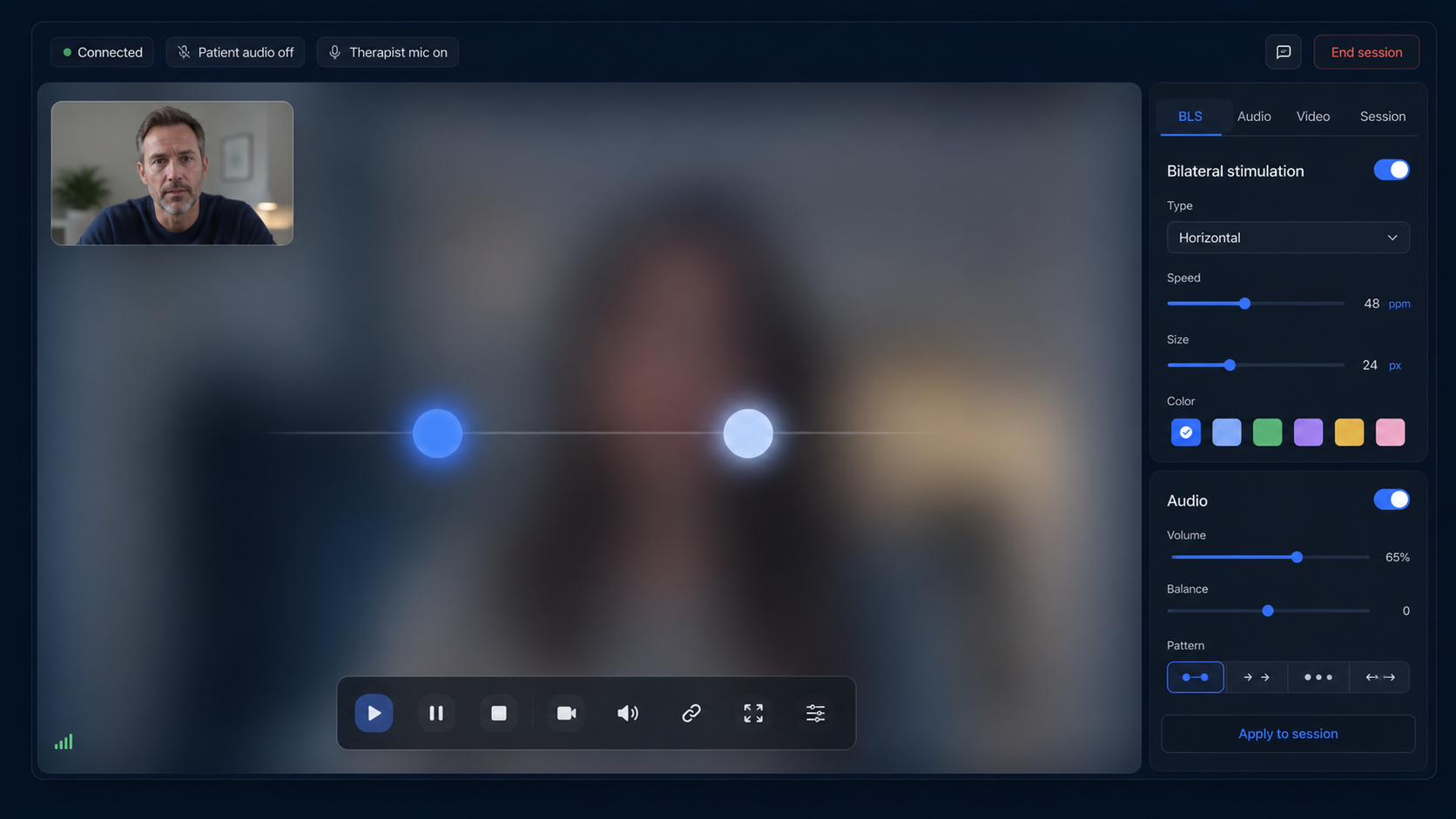
EMDRSuite can support the live therapeutic connection and BLS chosen by the therapist. It does not provide the Spiral script, detect direction, score SUD automatically, infer regulation, or authorize self-directed trauma work.
FAQ
EMDR Spiral Technique
Is Spiral Technique bilateral stimulation?
No. It is an imagery-based stress-management strategy focused on a body sensation.
Does reversing an imagined spiral prove a neurological mechanism?
No. A subjective change does not establish how it occurred or prove a literal rotating process.
Has Spiral Technique been tested in a controlled clinical trial?
No controlled outcome trial isolating it was identified through 28 August 2026.
Does EMDRSuite include the Spiral script?
No. It supplies remote-session technology, not scripts, automatic scoring, or clinical authorization.
References
EMDR Spiral Technique: purpose, evidence, and clinical limits
EMDRSuite
Put the guide into practice with EMDRSuite
Run remote EMDR with visual BLS, bilateral sounds, secure patient links, video-ready sessions, saved settings, and notes.
Continue with related EMDR guides