Reverse Protocol changes treatment order; it is not another name for a future template
EMDR Reverse Protocol vs future template and flashforward
Distinguish Reverse Protocol, future template, flashforward, and the standard three-pronged plan using evidence and training boundaries.
By the EMDRSuite Editorial Team
Product claims checked against the current EMDRSuite code and interface.
No independent clinical reviewer is named for this guide.
Reverse Protocol refers to sequencing, not one future image
EMDRIA describes Reverse Protocol as a conceptualization that may begin by reprocessing the future first or address the three prongs in reverse order. That is a treatment-order decision within trained EMDR practice, not a synonym for future template, flashforward, Flash Technique, or simply asking about tomorrow.
A flashforward is a disturbing feared catastrophe image. A future template rehearses an adaptive response to an anticipated situation. The standard three-pronged plan links past experiences, present triggers, and future responses. Similar future language does not make these tasks interchangeable.
Training availability is not outcome evidence
An official professional course and textbook references establish that a named approach is taught; they do not establish comparative efficacy. In the indexed and official sources reviewed through 28 August 2026, no controlled outcome trial specifically testing Reverse Protocol against standard sequencing was identified.
That evidence gap should be stated directly. Studies of standard EMDR, future imagery, or PTSD guidelines cannot be relabeled as trials of Reverse Protocol. Claims of faster treatment, restored hope, lower dropout, or special suitability require protocol-specific outcome data.
Guidelines support trauma-focused EMDR, not every adaptation
NICE, VA, and APA sources discuss trauma-focused EMDR for PTSD in defined contexts. They do not endorse every named sequence, script, training course, population, or online adaptation. Fidelity, formulation, consent, patient preference, competence, and outcome monitoring remain necessary.
Beginning with future material does not make current danger imaginary. Suicidal intent, coercion, violence, unstable housing, medical threat, psychosis, intoxication, legal risk, or missing practical skills require direct assessment and action, not only a reordered target sequence.
Do not turn a search result into a protocol script
Requests for a Reverse Protocol PDF or script often reflect legitimate training needs, but copying protected course or book material strips context, assessment, supervision, and authorship. Use authorized training and document the rationale for any adaptation without claiming unsupported superiority.
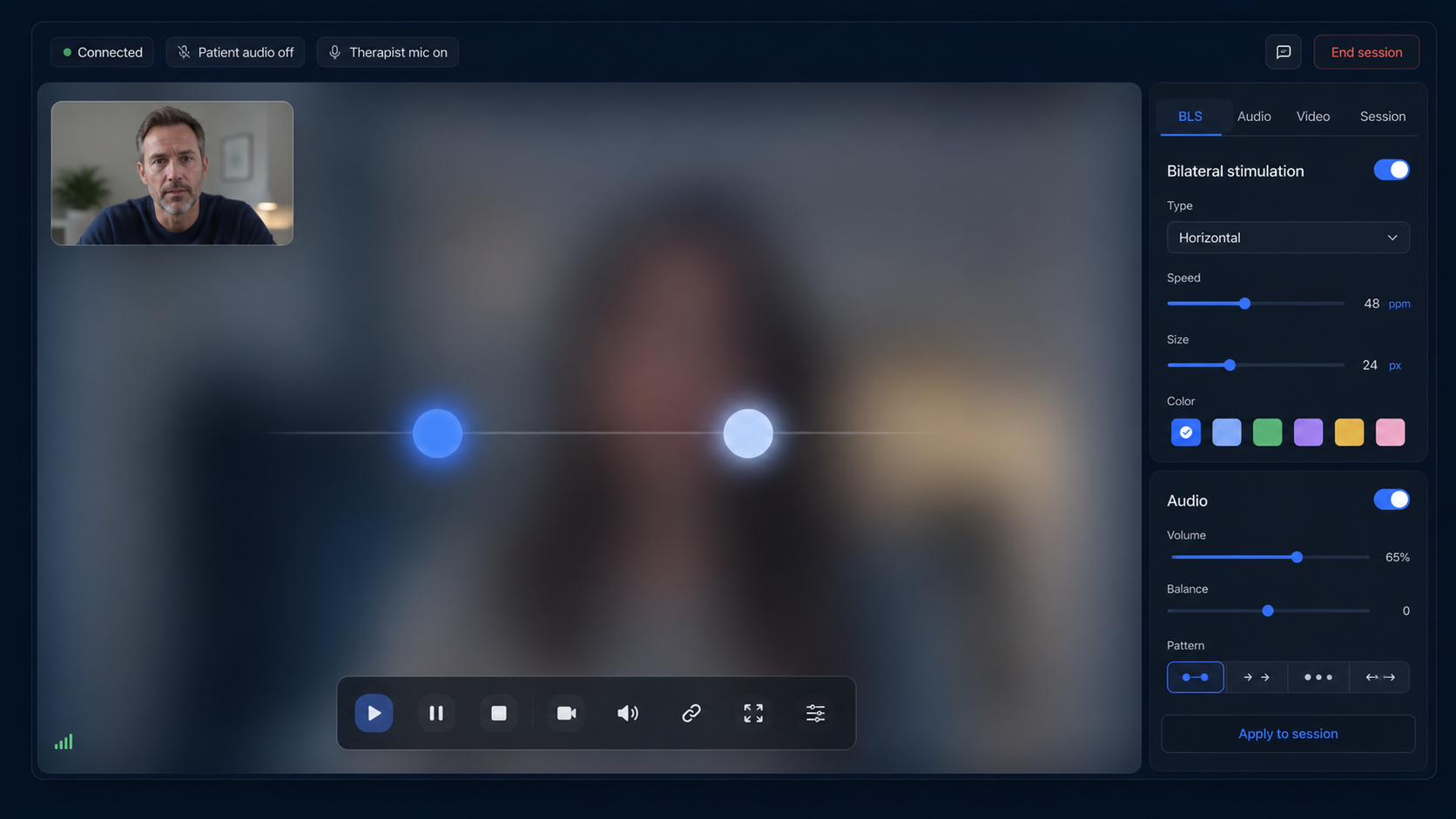
EMDRSuite can support therapist-controlled BLS and individual remote workflow. It does not recommend sequence, identify future targets, provide Reverse Protocol scripts, determine fidelity, assess risk, train therapists, or certify an adaptation.
FAQ
EMDR Reverse Protocol
Is Reverse Protocol the same as a future template?
No. Reverse Protocol changes treatment sequencing; a future template rehearses an adaptive future response.
Is it the same as flashforward?
No. Flashforward targets a feared future catastrophe, which is a different clinical task.
Has Reverse Protocol outperformed standard EMDR in trials?
No controlled protocol-specific comparison was identified in the sources reviewed through 28 August 2026.
Does EMDRSuite choose the treatment order?
No. It supports workflow and BLS but does not formulate, sequence, script, train, or decide clinically.
References
EMDR Reverse Protocol vs future template and flashforward
EMDRSuite
Put the guide into practice with EMDRSuite
Run remote EMDR with visual BLS, bilateral sounds, secure patient links, video-ready sessions, saved settings, and notes.
Continue with related EMDR guides