Treat the disorder that was assessed, not a generic fear of judgment
EMDR for social anxiety: evidence, diagnosis, and treatment choices
Evaluate EMDR for social anxiety against disorder-specific CBT, exposure, behavioral experiments, differential diagnosis, and the limits of direct evidence.
By the EMDRSuite Editorial Team
Product claims checked against the current EMDRSuite code and interface.
No independent clinical reviewer is named for this guide.
Social anxiety is more than shyness or low confidence
Social anxiety disorder involves persistent fear of scrutiny, negative evaluation, embarrassment, or rejection with avoidance or endurance under marked distress and meaningful impairment. It may be generalized or performance-focused, and it should not be inferred from quietness alone.
Assess feared predictions, self-focused attention, anticipatory worry, post-event rumination, safety behaviors, avoidance, panic, depression, substance use, body-image concerns, autism and communication differences, trauma, psychosis, medical factors, and whether the person actually wants more social contact. Do not pathologize culture, language, disability, introversion, or chosen solitude.
The direct EMDR evidence is a case report, not an efficacy trial
The indexed direct publication identified here is a 2019 report about one adult treated with EMDR for social anxiety disorder. A case can document feasibility and generate a hypothesis, but it has no randomized comparator, cannot separate treatment from expectancy or time, and cannot estimate typical benefit or harm.
A distressing humiliation, bullying event, or PTSD memory may be a legitimate treatment target after assessment. That does not establish EMDR as a complete social-anxiety protocol or show that memory processing replaces work on current predictions, avoidance, attention, and behavior.
Disorder-specific CBT has a much larger evidence base
A network meta-analysis included 101 trials and 13,164 adults. Individual CBT had the largest psychological-treatment effect and was the only psychological class clearly better than psychological placebo; exposure and social-skills approaches also outperformed waiting list. NICE recommends individual CBT developed specifically for social anxiety.
An updated meta-analysis included 66 randomized trials and 5,560 participants. Psychotherapy showed a large overall effect, g = 0.88, and an estimated number needed to treat of 3.8, but risk of bias and heterogeneity remained. These results do not prove every CBT component or format is equal, and they do not test EMDR.
Use memory targets without quietly dropping social learning
If EMDR is considered, define whether the target is PTSD, a specific adverse memory, a future image, or social-anxiety symptoms, and measure that outcome. Preserve informed choice about better-supported disorder-specific CBT, behavioral experiments, attention training, video feedback, and graduated social practice.
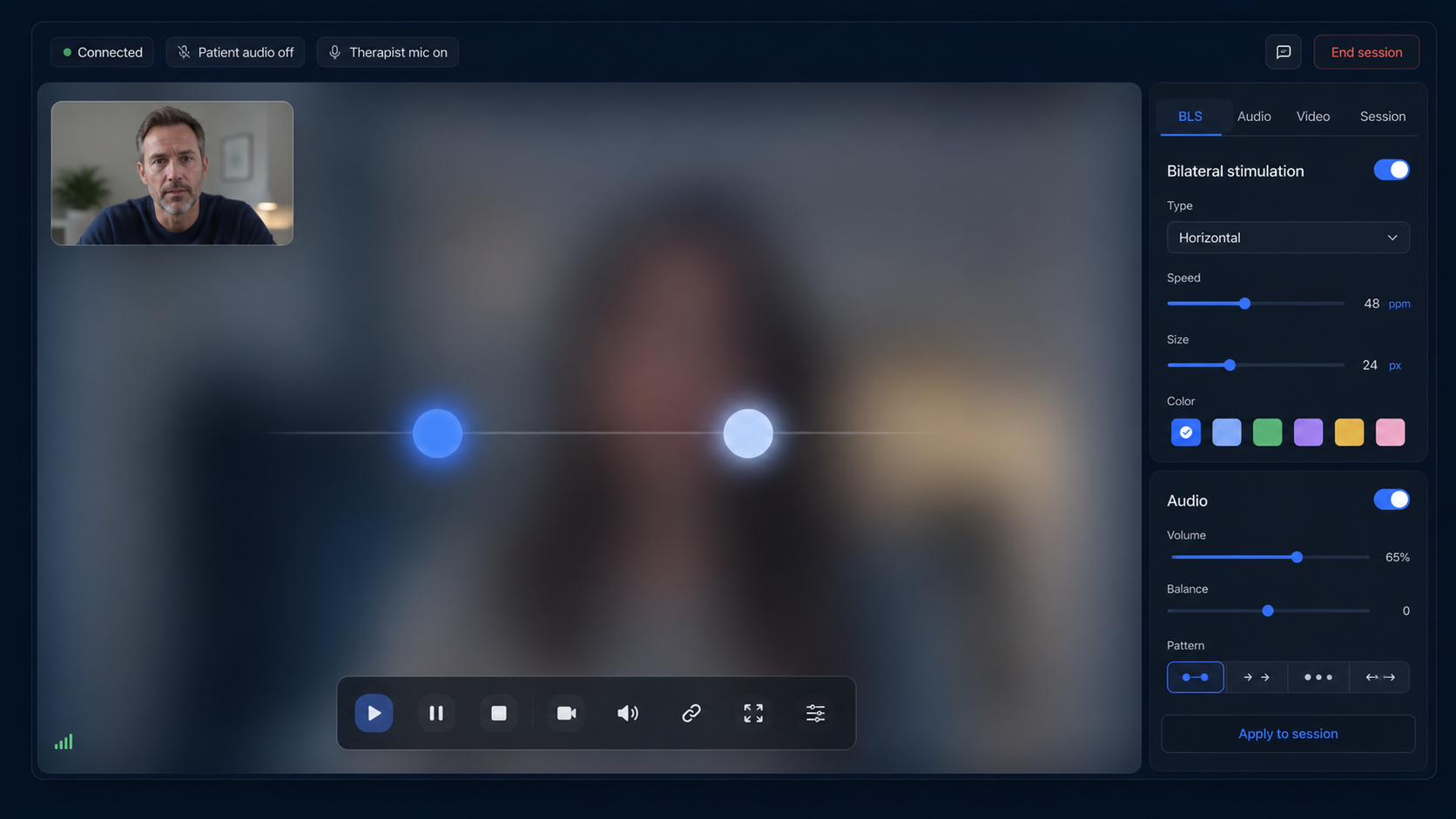
EMDRSuite provides therapist-controlled video, bilateral stimulation, worksheets, and records. It does not diagnose social anxiety, distinguish autism from fear, run behavioral experiments, provide exposure tasks, monitor substance or suicide risk, select memories, or guarantee social confidence. Those remain clinical responsibilities.
FAQ
EMDR for social anxiety
Is EMDR proven for social anxiety disorder?
The direct indexed evidence cited here is a single case report, not a controlled efficacy trial.
What treatment has the strongest evidence?
NICE recommends disorder-specific individual CBT, supported by large meta-analyses.
Can a humiliating memory still be targeted?
Yes when responsibly formulated, but that does not replace assessment of current avoidance and safety behaviors.
Can EMDRSuite diagnose social anxiety?
No. It is session software for qualified clinicians.
References
EMDR for social anxiety: evidence, diagnosis, and treatment choices
EMDRSuite
Put the guide into practice with EMDRSuite
Run remote EMDR with visual BLS, bilateral sounds, secure patient links, video-ready sessions, saved settings, and notes.
Continue with related EMDR guides