EMDR populations, displacement, and language access
EMDR with refugees and asylum seekers: evidence, ongoing threat, and interpreter access
A therapist guide to mixed EMDR evidence, displacement and ongoing threat, cultural formulation, interpreters, confidentiality, consent, humanitarian context, and remote care.
By the EMDRSuite Editorial Team
Product claims checked against the current EMDRSuite code and interface.
No independent clinical reviewer is named for this guide.
Displacement status is not a clinical formulation
Refugees, asylum seekers, forced migrants, and undocumented people are diverse in language, culture, legal status, migration route, family situation, education, faith, health, and goals. Trauma may coexist with ongoing danger, unstable housing, poverty, detention, discrimination, family separation, grief, pain, legal uncertainty, and practical needs that psychotherapy cannot resolve.
Assess PTSD and other conditions without assuming that every displaced person is traumatized or ready to recount events. Current safety, torture effects, psychosis, dissociation, suicide risk, medical needs, safeguarding, legal processes, social support, and access to basic services may alter timing and priorities. Humanitarian and legal support can be necessary alongside clinical care.
EMDR findings are mixed, not a universal refugee effect
A recent meta-analysis of ten randomized studies reported a nonsignificant pooled effect on PTSD symptoms at intervention end and highlighted heterogeneity. Individual trials have reported benefit, while another trial found trauma-focused EMDR safe but only limited efficacy compared with stabilization. Different settings, groups, protocols, controls, languages, and follow-up prevent a simple conclusion.
Discuss EMDR as one possible treatment when indicated and accessible, not as a rapid solution for displacement or a superior protocol for a nationality. Explain evidence uncertainty, alternatives, expected demands, current-threat limits, and what practical or specialist support remains outside therapy.
Interpreter-mediated therapy is a three-person clinical system
Use a qualified interpreter where available, not a child or family member by default. Pre-brief roles, confidentiality, impartiality, direct first-person speech, turn length, trauma terminology, stop signals, cultural clarification, boundaries, emotional impact, and debriefing. The patient should know what is translated, what is recorded, and how to raise concerns.
Interpretation changes pacing and may affect dual attention, BLS timing, observation, and privacy. Check comprehension rather than assuming word-for-word equivalence. Interpreter identity, dialect, gender, community ties, political context, and visibility can affect safety and willingness to disclose; preferences and alternatives belong in consent.
Remote access adds jurisdiction and data risks
Confirm location, emergency options, cross-border professional authority, device sharing, surveillance concerns, bandwidth, private space, interpreter connection, backup channels, and whether links or records could expose the person. Keep therapy records distinct from asylum evidence unless a separate authorized professional purpose and consent applies.
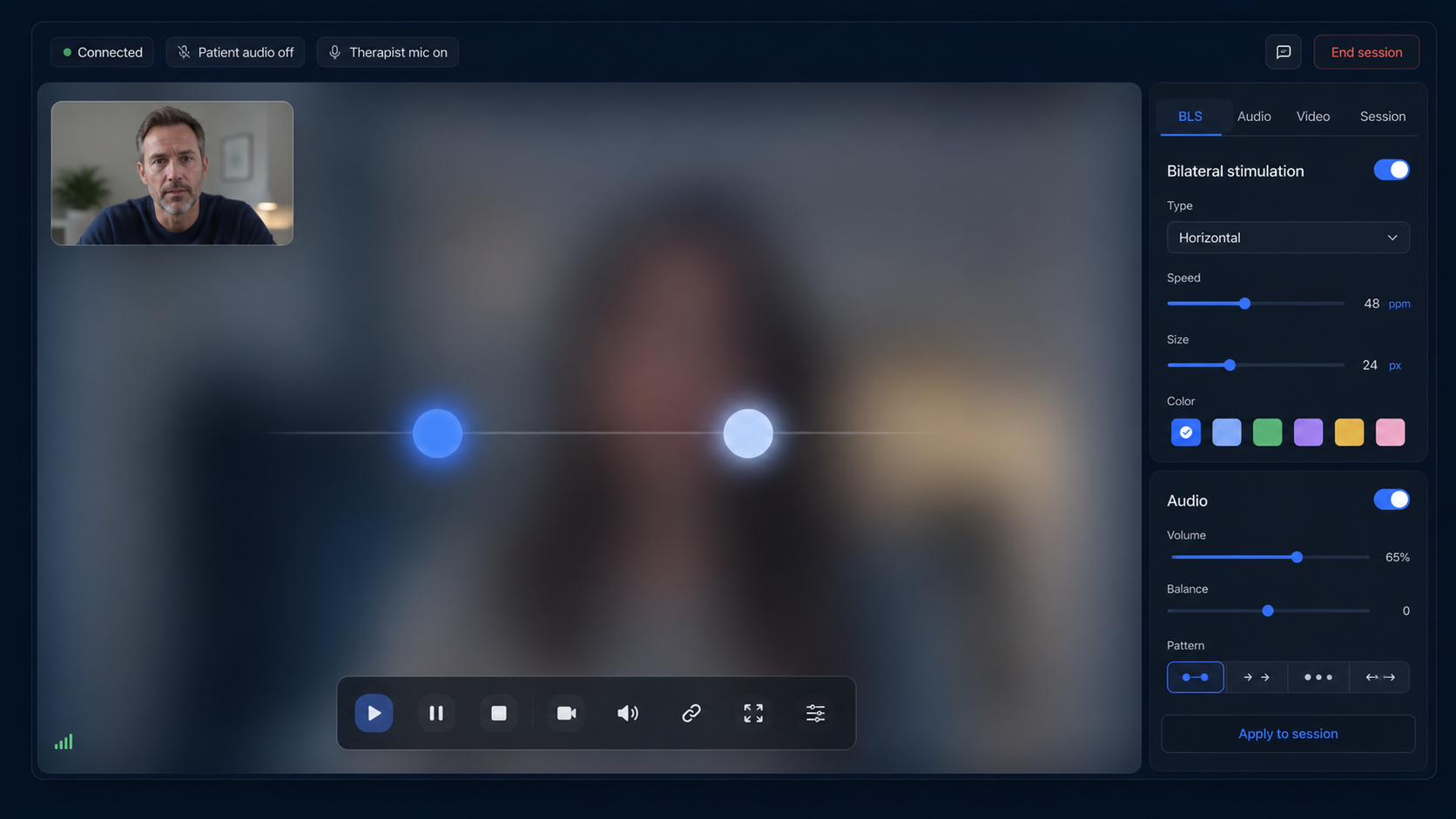
EMDRSuite can provide a therapist-controlled browser room, but it does not supply or vet interpreters, translate clinical meaning, assess asylum claims, provide legal or humanitarian help, determine safety, choose a group or individual protocol, or guarantee cross-border compliance. Minimize data and use an authorized service design for all participants.
FAQ
EMDR for refugees
Do all refugees need trauma therapy?
No. Displacement status is not a diagnosis; needs may be practical, medical, social, legal, psychological, or a combination.
Is EMDR clearly effective for every refugee population?
No. Trials and protocols vary, and a recent meta-analysis found a nonsignificant pooled effect at intervention end.
Can a family member interpret EMDR?
A qualified interpreter is generally safer for accuracy, confidentiality, roles, and consent; individual circumstances and local standards still apply.
Does EMDRSuite include interpreting or asylum support?
No. It supplies session technology, not interpretation, translation, legal assessment, humanitarian care, or cross-border authorization.
References
EMDR with refugees and asylum seekers: evidence, ongoing threat, and interpreter access
EMDRSuite
Put the guide into practice with EMDRSuite
Run remote EMDR with visual BLS, bilateral sounds, secure patient links, video-ready sessions, saved settings, and notes.
Continue with related EMDR guides